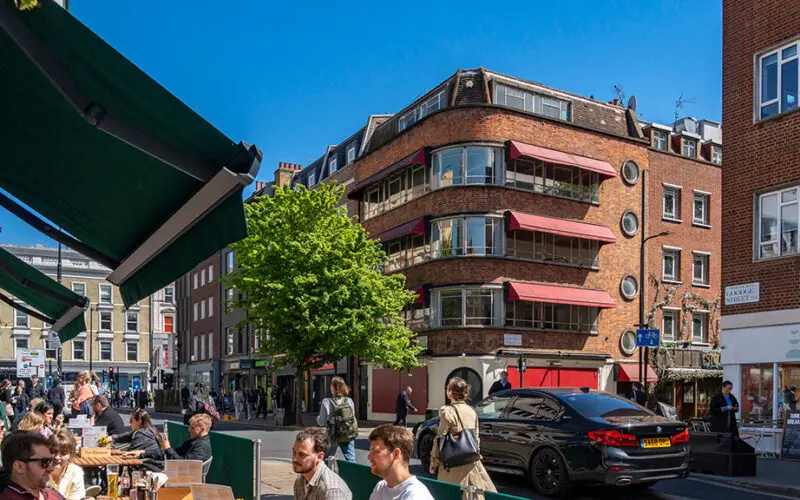
The UK office construction slowdown has reached its deepest point in more than 20 years, and the squeeze it is creating in prime space is handing London landlords their strongest pricing power in a generation.
Work began on just under 4.5 million sq ft of new offices across the country in the 12 months to the end of June, according to CoStar. That is roughly nine Gherkins’ worth of floorspace for an entire nation.
It is the lowest annualised figure the real estate analytics provider has recorded since the end of 2004, and half the volume being started in the aftermath of the global financial crisis. At the 2007 peak, developers broke ground on close to 24 million sq ft.
Debt costs, build inflation and a shrinking regional pipeline
Patrick Scanlon, senior director of analytics at CoStar, attributed the retreat to “a combination of persistent economic uncertainty, the high cost of debt and inflated construction and labour costs”.
The pain is not evenly spread. In 2021, roughly half of all UK office space under construction sat in London. That share has now climbed to 73 per cent, which CoStar described as “one of the highest ratios on record” and the most in at least 20 years.
Regional developers face broadly the same build and financing costs as their London counterparts but nothing like the same rents. In Manchester, the best offices were letting at about £45 per sq ft last summer, according to Savills research on the Manchester office market.
The viability problem is not confined to offices. Housebuilders have trimmed their ambitions over the past year or so, margins caught between markedly higher costs and stagnant house prices. S&P Global’s UK construction purchasing managers’ index has been lingering at six-year lows, well below the level that would signal year-on-year growth.
Why £100 per sq ft rewrites the development maths
For office developers in the capital, the arithmetic is improving regardless. Occupiers increasingly want prime space, there is not enough of it, and the shortage has driven a rapid repricing. Knight Frank estimates prime City rents have risen by 46 per cent since 2020, while West End rental growth has totalled 68 per cent over the past six years.
Most best-in-class City buildings now command more than £100 per sq ft a year, even though the Square Mile remains cheaper to rent than the West End. That is the level at which speculative schemes begin to pencil, and it goes some way to explaining why the capital is absorbing what little construction activity remains. It is also why the shortage of top-grade space is pushing occupiers into second-tier buildings.
The counterpoint for investors is straightforward. Fewer starts today means less competition tomorrow.
A growth agenda meets a stalled crane count
The regional picture will make uncomfortable reading in Downing Street. Andy Burnham, the new prime minister, has made “growth in every corner of the country” a defining pledge, yet the crane count outside London is at its thinnest in two decades.
Scanlon suggested the political backdrop is part of the problem, saying uncertainty in the UK and questions about where Burnham wanted to take the country had “added to [developers’] nervousness about pushing the button on new projects”. Portfolio investors are already modelling what a reshaped property tax system might mean for holding periods and exit timing.
What this means for investors
Two positions sit inside this data. The first is scarcity. Existing prime London offices become more valuable simply because so little is being built to compete with them, and rent reviews over the next three to five years should reflect it.
The second is refurbishment. With ground-up development still hard to underwrite outside the core, upgrading tired stock in strong locations is the quicker route to prime rents, a logic that has already prompted large landlords to rebalance portfolios away from office development.
Outside London the calculation is harder. Until regional rents move closer to build costs, or costs come down, the offices being leased in Manchester, Leeds and Bristol at the end of this decade are largely the ones standing today. That argues for buying existing quality in regional centres rather than waiting on new supply that may never be delivered.