Canary Wharf Group and Qatar Investment Authority have submitted plans to Tower Hamlets Council for the mixed-use overhaul of 8 Canada Square, marking the estate’s biggest Canary Wharf office conversion to date
Canary Wharf Group (CWG) and the Qatar Investment Authority (QIA) have lodged proposals with Tower Hamlets Council for the mixed-use redevelopment of the 45-storey tower that has served as HSBC’s global headquarters since 2002.
For investors, it is the clearest signal yet that the estate’s answer to a decade of structural change in office demand is not demolition, but reinvention.
Who owns the asset, and who is writing the cheque
The tower is fully owned by QIA, with CWG acting as development partner and the sovereign wealth fund providing the major investment to overhaul the asset.
That structure matters. Capital risk sits with a state-backed balance sheet and a very long holding horizon, while CWG contributes delivery expertise and estate-level control over the wider public realm.
CWG has described the project as the world’s largest transformation of a headquarters office tower into a mixed-use building. Proposals were first unveiled in July 2024, and the planning application now confirms a retrofit-led scheme rather than a rebuild.
A hotel, a viewing experience and a covered street
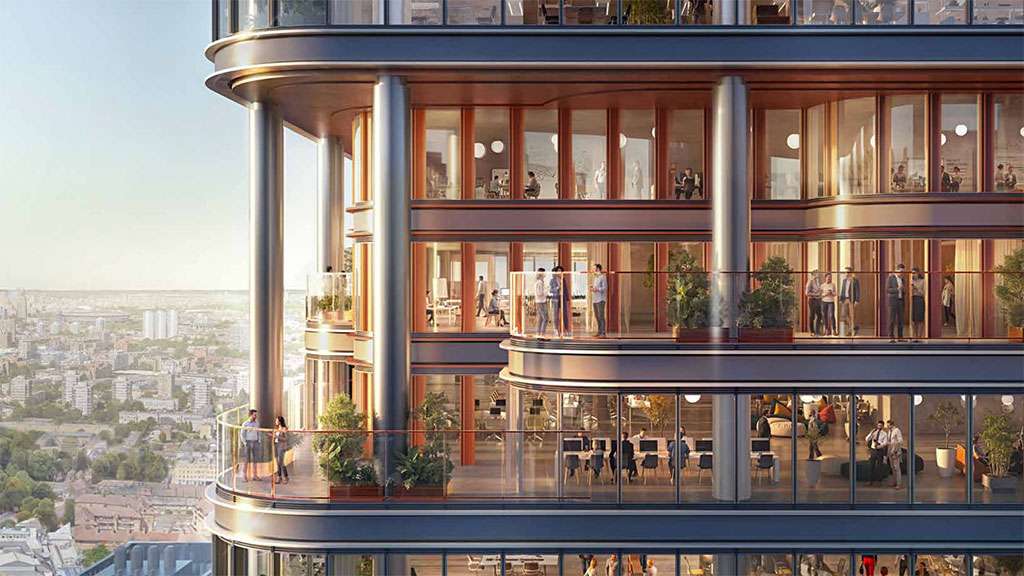
Under the application, offices spanning floors two to 33 would be refurbished. Levels 34 to 41 would be converted into a 181-room luxury hotel, with leisure uses including a visitor experience called The Cloud occupying the top four floors.
At ground level, CWG proposes a new public route through the tower’s base, called The Street, which would be lined with restaurants, shops and pop-up space.
Much of the existing 1.1m sq ft building would be retained, with large sections of the facade removed to create a series of terraces and balconies. The scheme has been designed by architects Kohn Pedersen Fox, which won a design contest in which 20 architects pitched alternative plans for the tower.
Why the retrofit route appeals to institutional capital
Keeping the frame is a cost and carbon calculation as much as an architectural one. Retaining structure shortens programmes, reduces embodied carbon exposure and, crucially for a sovereign investor, limits the sunk cost of a scheme that has to work across multiple market cycles.
Landlords further down the size scale have been running a version of the same arithmetic. Change-of-use activity has been climbing steadily, with commercial-to-residential conversion applications rising 63 per cent between 2021 and 2023 according to research by Direct Line, and specialist buyers have been acquiring unwanted office buildings at scale precisely because the numbers work better on a change of use than on a re-let.
The hotel component is the more interesting bet. Converting redundant office floors into rooms has become a recognisable London play, seen most recently in the £245m sale of the Ministry of Justice headquarters to Arora Group, where a luxury hotel redevelopment is widely expected once the lease expires.
Splitting a single-let tower into offices, hotel rooms and leisure space also spreads income across three cycles that rarely turn in unison. That is a meaningfully different risk profile from a 1.1m sq ft building let to one bank.
The timing question
HSBC leaves the tower next year, relocating to a smaller office in the City, and redevelopment is set to begin at that point. A void of that length would be uncomfortable for most owners, which is one reason this scheme was only ever viable for capital that does not need to show an annual return.
The wider estate backdrop has improved. Canary Wharf’s office vacancy rate fell from 13.7 per cent to 11.2 per cent over a single quarter, according to Knight Frank data, leaving it close to its long-run average after heavy absorption of second-hand space. Tower Hamlets has separately welcomed JPMorganChase’s decision to build a new headquarters on the estate.
What this means for investors
The application is a test case with consequences well beyond E14. If a 45-storey tower can be reconfigured into offices, hotel and leisure without coming down, the residual value floor under every ageing large-floorplate office in London moves upward.
Watch the determination timetable at Tower Hamlets, and watch whether the hotel and leisure elements survive the planning process intact. Those uses carry the placemaking argument, and they are the part of the scheme most exposed to viability pressure. Investors holding secondary Docklands stock should be reading this application as a pricing signal, not a curiosity.