

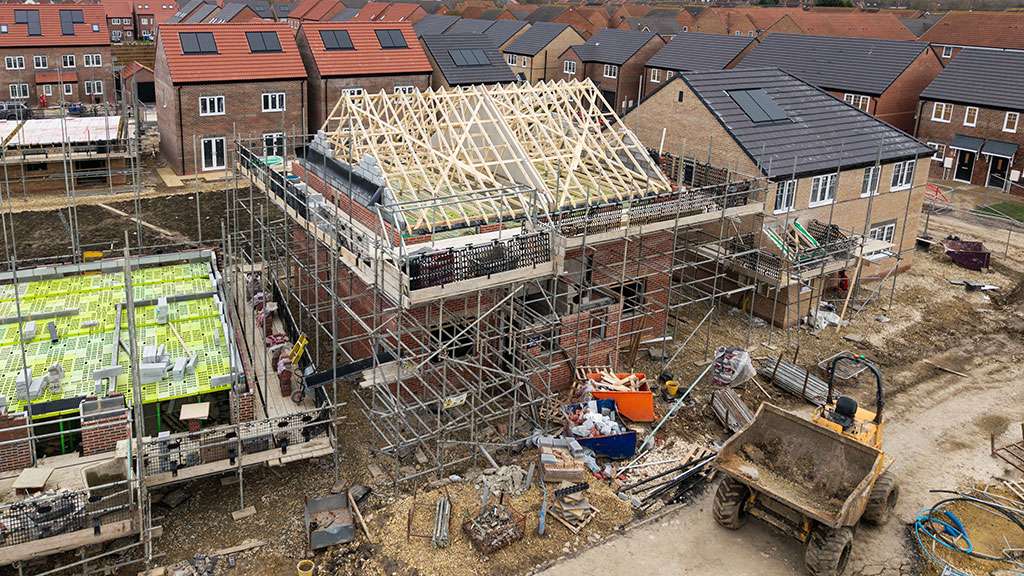
Andy Burnham has quietly dropped the most radical element of his housing offer. Affordable homes programme funding is to be spread across the full range of subsidised tenures rather than pointed exclusively at council homes, after the Prime Minister set out on Monday 24 August 2026 how the first slice of the 10-year programme will be spent in England.
The approach follows the policy design of the Starmer government, and the money comes from the £39bn housing settlement agreed at the 2025 spending review. Before entering Number 10, Mr Burnham had argued the entire pot should go to social homes, which carry heavier subsidy and lower rents than other government-funded housing.
What the first wave actually buys
Just under £10bn, £9.58bn precisely, will fund more than 70,000 social and affordable homes outside London across the decade, with at least 60 per cent earmarked for social rent. The remainder covers other subsidised tenures, among them shared ownership and sheltered accommodation.
A further £6bn has been confirmed for London through the Greater London Authority. More than £16bn of the programme outside the capital remains unallocated, and officials say social rent and council houses will take priority in later rounds.
Thirty-three strategic partners have been granted guaranteed funding across the 10 years. Three are local authorities: Cambridge City, Eastleigh Borough and Newcastle City.
The cash tracks the mayoral city regions. Greater Manchester receives £529m for about 4,400 homes, the North East £445m for 3,400, West Yorkshire £441m for 4,000, the West Midlands £409m for 3,200, Liverpool City Region £380m for 3,100 and South Yorkshire £249m for 2,200, according to [the Government’s announcement](https://www.gov.uk/government/news/historic-council-housebuilding-comeback-to-help-families-into-secure-homes).
From “control matters” to “a pragmatic approach”
Launching his campaign to become MP for Makerfield, Mr Burnham was unambiguous about where he wanted the money to go.
“There’s £39bn allocated over a 10-year period … I’m saying that should be dedicated to council homes. Let’s not be coy any more … I’m saying council homes because control matters,” he said.
The version he is now delivering is softer. “Nearly £10bn will go to councils and housing associations to build genuinely affordable homes, most of them for social rent, in the places where families are waiting longest,” the Prime Minister said, adding that councils “built this country out of a housing crisis once before” and, “backed properly, and trusted to get on with it, they will do it again”.
Housing minister Matthew Pennycook described the allocation as “a pragmatic approach” designed to “get money out the door”.
Sir James Cleverly, the shadow housing secretary, called it “a sleight of hand” and “yet another unfunded spending commitment”, arguing that “the funding has been backloaded to fall outside the Spending Review and this Parliament”, with “the small print” showing “homes won’t have to be delivered until 2039”.
Supply that barely dents the waiting list
Some 1.34 million households were on social housing waiting lists in March 2025, and 177,530 children were homeless in temporary accommodation.
In 2024-25, around 65,000 affordable homes were completed across England, of which just over 12,000 were for social rent. About 203,000 new homes of all types were delivered in the 12 months to June 2026, against the 300,000 a year the Government needs to hit its 1.5 million target by 2029, a goal critics have already dismissed as political fantasy.
Sarah Elliott, chief executive of Shelter, said the money “puts councils back on the pitch” but warned of “underlying obstacles which hold councils back from building”, including “unsustainable housing debt”.
What this means for investors
For landlords, the headline reads worse than the substance. This wave buys roughly 7,000 subsidised homes a year outside London, no threat to private rented demand against a waiting list of 1.34 million households, particularly while rental supply keeps shrinking.
That is a quarter of the money, though. The full £39bn targets around 300,000 homes, so the run rate should climb once later rounds land, and the programme documentation confirms delivery runs well past 2030.
The more useful signal is where the shovels go. Six city regions now have decade-long funding certainty, which supports land values, contractor pipelines and build-to-rent viability in the same postcodes, while councils become competing bidders for the sites investors want.
The political read matters too. A Prime Minister who campaigned on council homes alone and settled for the inherited mixed model is one who compromises under Treasury pressure, which is mildly reassuring for a sector braced for intervention. The Budget will tell landlords far more than this allocation does.
The £16bn still unallocated is the number to watch. If it tilts hard towards social rent, the direction of travel Mr Burnham promised is only delayed, not abandoned.


